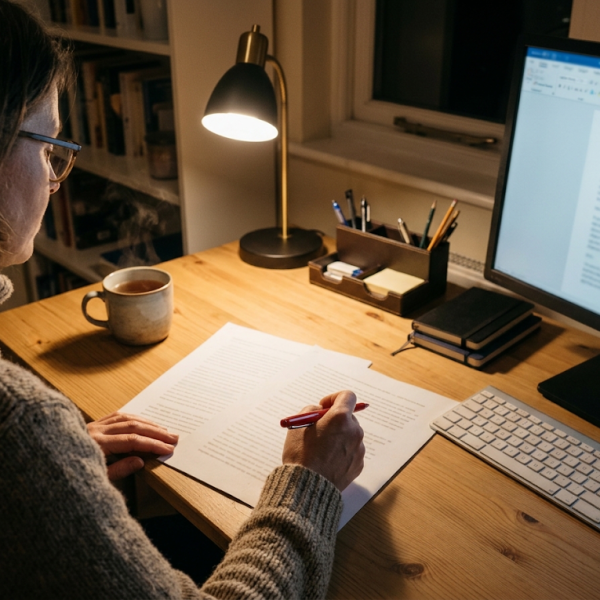
A translation can be accurate and still not be ready for publication. Even skilled linguists make small slips when they work for hours on a long text, such as a repeated word, a missing comma, a wrong number format or a term that was spelled in two different ways. These slips are easy to overlook for the person who wrote the text, because the brain tends to see what it expects to see. That is the reason professional workflows add a separate proofreading stage, carried out by a second person who reads with fresh eyes. Proofreading is the last safety net between your text and your readers, and it costs far less than correcting a mistake after printing, uploading or sending a document to a client. This article explains what proofreading covers and how to get the best result from it.
Translation, Editing and Proofreading Are Different
The three words are often used as if they meant the same thing, but each describes a different task. Translation moves the meaning from one language to another. Editing, sometimes called revision, compares the translation with the source and checks accuracy, completeness, terminology and style. Proofreading comes last and looks at the final text for surface errors, including spelling, grammar, punctuation, spacing, formatting and consistency. In a high quality workflow the same person does not perform all three stages, because a fresh reader will notice problems that the original translator cannot see anymore. Understanding the difference helps you ask for the right service and avoid paying for the wrong one.
What a Proofreader Actually Checks
A proofreader reads the text slowly, often several times, and watches for many different issues. These include typing errors, inconsistent capitalisation, mixed spelling standards, incorrect hyphenation, broken numbering and mismatched cross references. They also check that headings follow the same style, that dates and numbers use the correct format for the target market and that names are spelled the same way throughout. In a layout file, such as a brochure or a presentation, they also look at line breaks, missing characters caused by font problems and text that has been cut off. Good proofreaders keep a style sheet so that every decision is recorded and can be reused in future projects.
Why Machines Are Not Enough
Spelling and grammar tools are useful, but they cannot replace a human reader. They often miss words that are correct but wrong in context, such as form instead of from, and they do not understand brand style, regional preferences or the purpose of the text. Software may also flag perfectly good phrases or approve sentences that sound unnatural. Automatic translation adds another layer of risk, because the output can look smooth while hiding errors in meaning. This overview of mistakes machines still make shows why a human check remains essential for anything that represents your company in public.
Proofreading in the Target Language
The best results come when the proofreader is a native speaker of the target language who also understands the subject. A French text, for example, requires careful attention to accents, spacing before punctuation, gender agreement and the formal or informal forms of address. If you plan to publish in France, Canada or Africa, it also helps to confirm the regional norms. Companies that regularly need english to french translation usually ask for a separate native reviewer to read the final proofs before release. This extra step catches mistakes that the original team missed and gives managers confidence when they approve the text.
How to Brief a Proofreader
Give the proofreader as much information as possible. Explain the purpose of the text, the intended audience and the style you prefer, and share the glossary, the style guide and the source document if a comparison is needed. State clearly what you want them to do, for example whether they may change wording or should only correct errors, because this affects both the cost and the result. Provide the final layout file if you have one, since problems often appear only in the finished design. The Chartered Institute of Editing and Proofreading offers useful standards and guidance for choosing qualified professionals and understanding what they do.
Build Proofreading Into Your Schedule
Many projects run late because proofreading is added at the very end, when the team is already under pressure. Plan for it from the beginning, reserve time between translation and publication and make sure that all changes are approved before the proofreader starts. Once the text is finalised, avoid last minute edits, since they can introduce new errors that nobody checks. After publication, collect feedback from readers and update your glossary and style sheet. With a consistent routine, your translated texts will look polished, read smoothly and reflect the care that your customers expect from a trustworthy company.
A final tip is to read the text in the format your audience will see it. A website should be checked in a browser on both a computer and a phone, a brochure should be viewed as a print proof and a presentation should be played through in slide mode. Many small problems, such as overlapping text or a missing accent, only become visible in the final medium, and catching them at this stage protects your reputation.